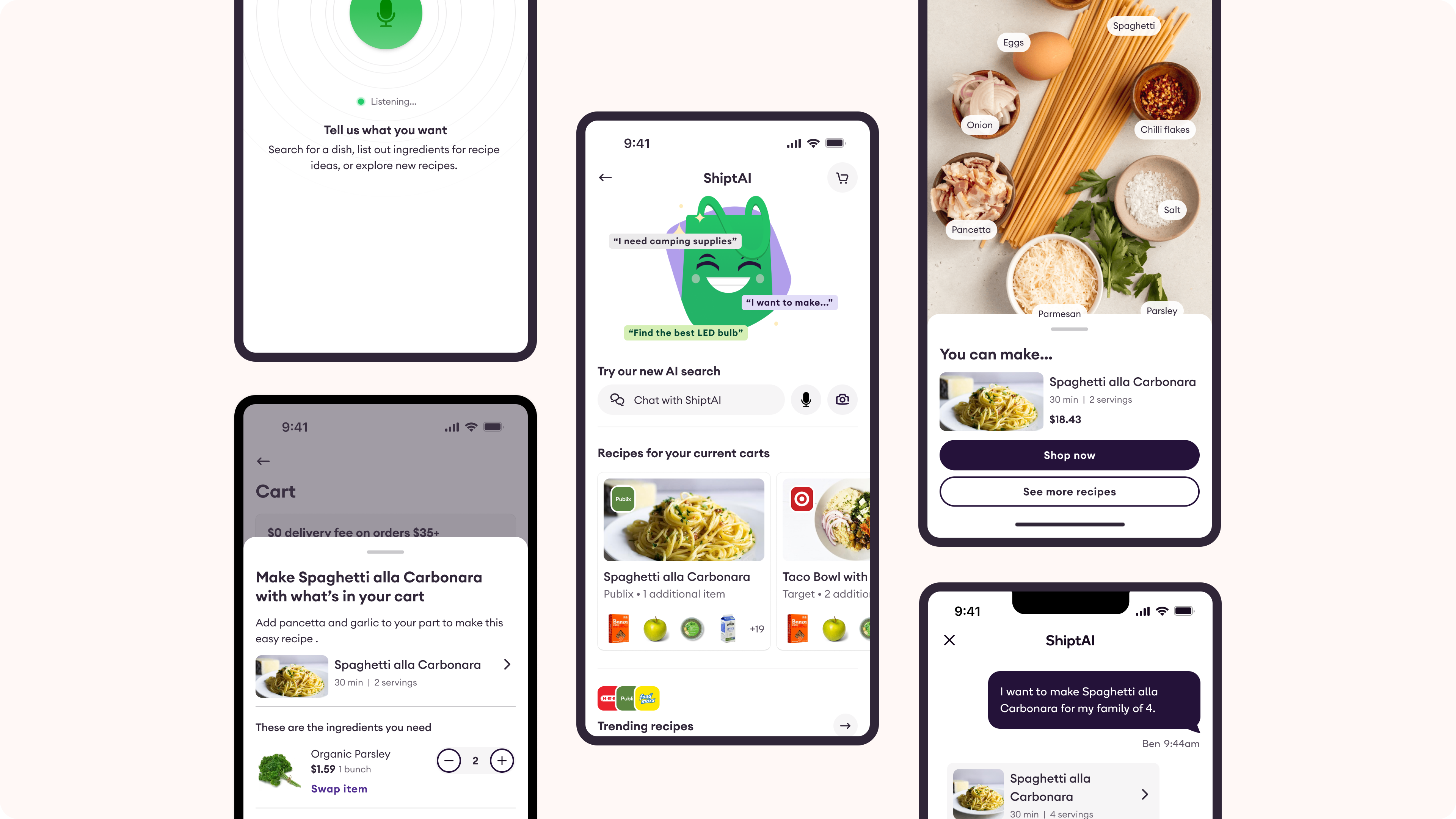
This project was conceived and designed during a three-day internal hackathon. The constraint wasn't just time — it was clarity. In 72 hours, we needed to identify a meaningful user problem, define an AI-native opportunity, and prototype a scalable vision.
"Getting Shipt Done" was an exploration into how generative systems can transform content discovery into an intelligent, personalized planning experience embedded directly inside commerce.
The ambition wasn't to add recipes. It was to design a human-AI system that reduces cognitive load, earns trust, and meaningfully changes behavior.
From Content Consumption to AI Collaboration
Meal planning is a high-friction, high-frequency decision. Research showed that 80% of users spend 30+ minutes weekly searching for meal ideas.
Competitors largely offered:
- Static recipe feeds
- Content partnerships
- Basic "add to cart" integrations
Discovery, personalization, and shopping were disconnected.
We designed an AI-native system that blended:
- Recipe discovery directly inside search
- Ingredient matching against live cart state
- Smart cart completion recommendations
- Personalization based on dietary, household, and budget context
- Conversational planning concepts (text-to-cart, voice, AI agents)
The goal was not inspiration. It was collaborative planning.
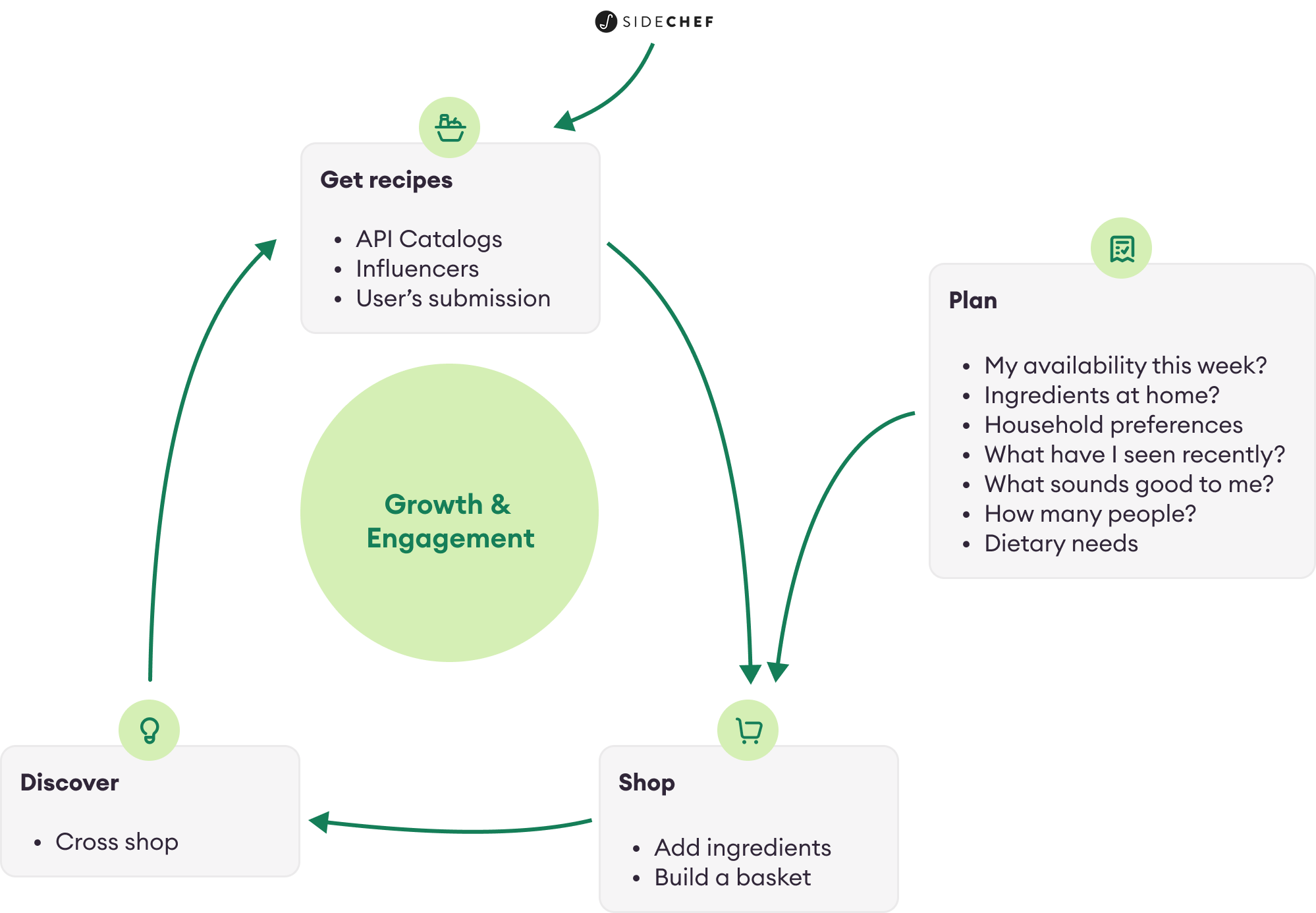
The Meal Planning Flywheel
At the core of the experience was a behavioral system, not a feature.
At the center sat a personalization engine — the Shipt AI Meal Planner.
Each loop strengthened engagement:
- Curated recipe content fueled planning
- Planning generated shoppable baskets
- Shopping created behavioral signals
- Feedback refined personalization
- Personalization improved the next discovery cycle
AI acted as connective tissue between content and commerce. Recipes stopped being endpoints. They became inputs into a dynamic system.
Designing for Human-AI Trust
When AI touches food routines, spending, and family preferences, precision matters.
The design challenge wasn't novelty — it was clarity.
We ensured:
- Ingredient substitutions were transparent
- Cart additions were reversible and predictable
- Personalization signals felt earned, not intrusive
- Recommendations were contextual, not noisy
Strong interaction design and visual hierarchy ensured the AI layer felt assistive, not overwhelming.
AI as Infrastructure, Not Feature
This was not a chatbot experiment. It was a system-level integration of AI into content and commerce.
We explored roadmap extensions including:
- Retailer-agnostic baskets
- Cross-shop personalization
- Voice-driven meal planning
- Camera-based ingredient recognition
- Context-aware intent modeling
The architecture was intentionally built to scale across surfaces and modalities.
AI Tools & Workflow
We used AI not only in the product vision, but in the process itself. Our workflow incorporated:
- Figma for rapid prototyping
- Dovetail for research synthesis
- Ollama for local LLM experimentation
- ChatGPT for content enrichment and conversational flow modeling
- UserTesting for validation
- v0 for structured insights
AI supported:
- Recipe enrichment
- Conversational interaction modeling
- Personalization logic framing
- Scenario simulation
- Rapid iteration on content systems
The system was designed with AI fluency embedded at both the product and process layers.
Why This Work Matters
This project reflects how I approach AI-powered content systems:
- Start with human friction
- Design AI as connective infrastructure
- Prioritize clarity and trust
- Think in flywheels, not features
- Build for cross-surface scale
AI-native experiences should not overwhelm users with possibility.
They should reduce effort while preserving agency.
This work represents a move from static content feeds to adaptive, intelligent media systems — designed to operate at consumer scale.